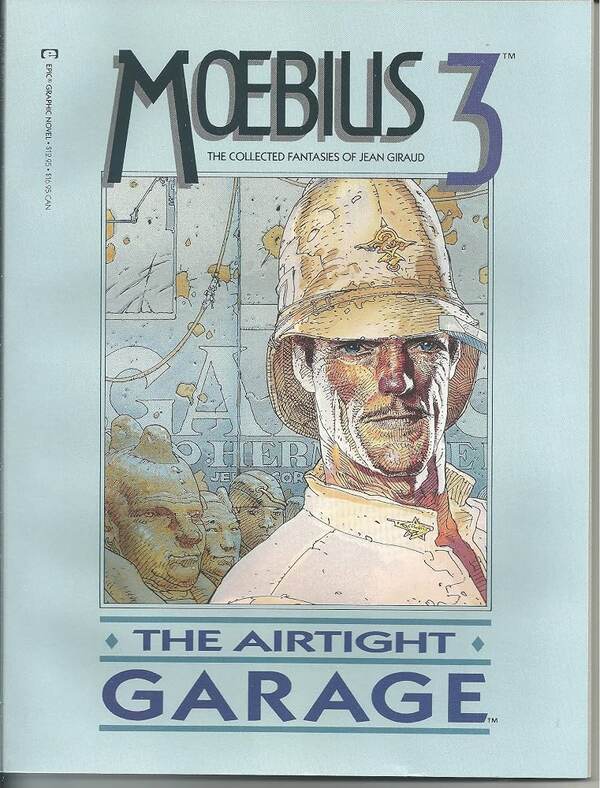
The Airtight Garage
Mœbius (Jean Giraud)
A world keeps changing its own rules, and Mœbius invites the reader to keep moving through it.
Overview
Mœbius's The Airtight Garage, also called Le Garage Hermétique, began in the French magazine Métal Hurlant in 1976. It developed in short serial episodes, building an unstable realm around Major Grubert and the realities connected to him. The story's continuity is playful rather than strictly explanatory.
That looseness is part of the experience. A new setting or figure can redirect the narrative before the last one has settled. The reader follows recurring motifs and visual logic as much as a conventional chain of causes.
Why It Matters
The work gave Mœbius room to test what a serialized science-fiction comic could do when each installment might change direction. Its formal freedom is visible in the way the world expands without becoming a neatly mapped franchise setting.
Humanoids continues to catalog it as a substantial stand-alone Mœbius work. Its significance lies in the invitation to read invention itself as the story: the surprises are not simply obstacles for a protagonist but changes to the terms of the fictional world.
The Science Fiction
Alternate realities and shifting environments replace a single stable future. The comic uses speculative space as something elastic: geography and identity may become uncertain as the story proceeds.
That makes its science fiction unusually close to surrealism. Rather than asking whether a device is plausible, it asks what happens when the reader accepts each new possibility and follows the consequences for another few pages.
Art & Visual Identity
Mœbius's pages can move from fine architectural detail to open, strange expanses. He gives each new scene a visual premise that feels complete in the moment, even when the wider story remains unresolved.
The changing settings let line, texture, and scale become narrative tools. A panel may offer a precise object to hold onto while everything around it seems provisional. That balance makes the comic adventurous to look at as well as to read.
Read This If You Like
- Surreal science fiction
- Experimental serial storytelling
- Alternate realities with shifting rules
- Mœbius's early Métal Hurlant work