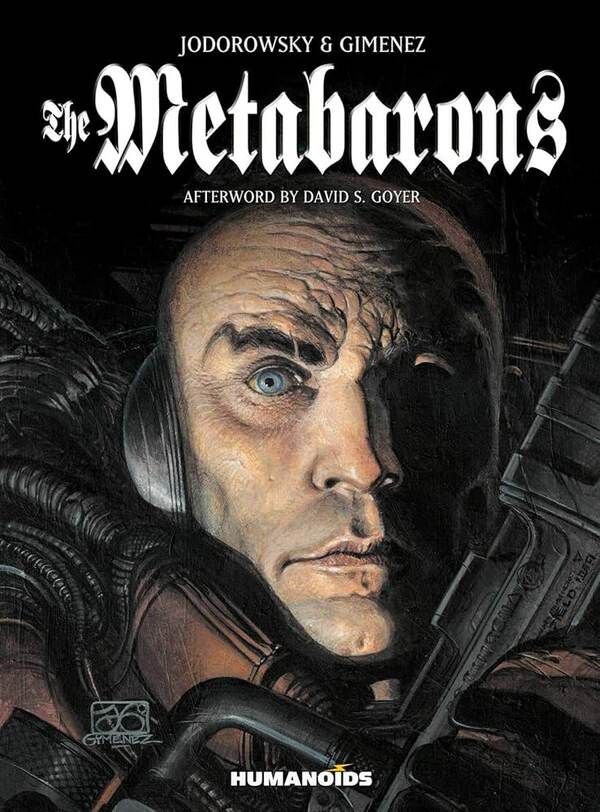
The Metabarons
Written by Alejandro Jodorowsky. Art by Juan Giménez.
In this family, inheritance is won by surviving the person who raised you.
Overview
Alejandro Jodorowsky and Juan Giménez began The Metabarons in 1992, expanding a warrior lineage first glimpsed in Jodorowsky and Mœbius's The Incal. The original cycle spans eight books through 2003. It tells the history of a succession of near-immortal galactic fighters, each generation shaped by the family's severe code.
The premise turns genealogy into conflict. Cybernetic implants mark each Metabaron, while succession requires a mortal contest between father and son. Battles across a vast galaxy matter, but the most persistent pressure comes from inside the dynasty: the desire to preserve its power by demanding sacrifice from its own heirs.
Why It Matters
The series takes a figure from The Incal and asks what sort of history could produce him. That shift from a singular warrior to a lineage gives the space opera a tragic structure. Every technological enhancement appears as both a source of strength and a record of damage passed forward.
Humanoids credits Giménez's expansive painted art with giving emotional weight to Jodorowsky's mythology. The original cycle is also distinct from later Metabarons continuations: this profile concerns the Jodorowsky–Giménez books, where the visual scale of machines and ships is inseparable from the family story.
The Science Fiction
Cybernetic alteration makes the body a site of inheritance. Each Metabaron is remade for combat, so improvement carries an uncomfortable question: what parts of a person may be sacrificed to keep a dynasty powerful? The family's wealth and technology make that private ritual consequential across the galaxy.
The setting has the breadth of mythic space opera, with immense craft and violent struggles for power. Its speculative inventions are rarely neutral tools. They intensify an older pattern of coercion, turning parental expectations and status into physical transformations.
Art & Visual Identity
Giménez sets small figures against huge vessels and densely built machinery. His painted surfaces give metal, stone, and flesh distinct weight, making the scale of the world feel oppressive as well as grand. A warrior may command the frame, then appear almost lost inside the structures created by the family's power.
The art balances spectacle with bodily cost. Cybernetic detail draws attention to what the characters have gained, while faces and posture keep the price visible. That tension prevents the series' ornate design from becoming mere decoration: its most memorable images make strength look difficult to carry.
Read This If You Like
- Dynastic space opera
- Cyborg bodies and inherited power
- Tragic family sagas on a galactic scale
- Densely painted science-fiction art