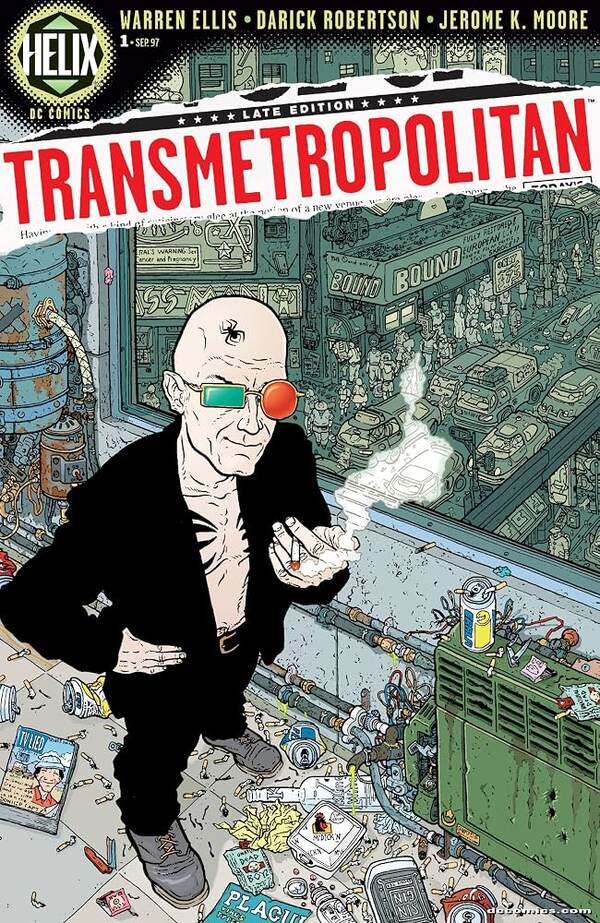
Transmetropolitan
Written by Warren Ellis. Art by Darick Robertson.
A reporter returns to a city built to overwhelm him, then starts asking who benefits from the noise.
Overview
Warren Ellis and Darick Robertson's Transmetropolitan began in 1997 under DC's Helix imprint and later moved into Vertigo. Its central figure, Spider Jerusalem, is a furious investigative journalist writing for The Word in a crowded, technologically saturated future city. His investigations move from strange local subcultures to abuses of political power.
The series gives Spider a difficult role: he can expose what powerful people want hidden, but he is abrasive and self-destructive enough to make the work messy. The city's extremes supply comedy and shock, while the longer narrative asks whether reporting can still matter when institutions are adept at turning every event into spectacle.
Why It Matters
DC identifies the comic as part of Helix's cyberpunk program before that imprint was folded into Vertigo. The publication path fits the work's mix of speculative invention and adult political satire. Spider's reporting gives its episodic outrages a continuing purpose: each absurd new technology or custom is also a clue to how the city treats its residents.
The comic's most durable idea is that information does not automatically create accountability. Spider has to gather evidence, publish it, and face the people who would rather bury it. The future setting enlarges the problem instead of solving it; more media means more opportunities to confuse, distract, and sell.
The Science Fiction
The city permits radical bodily alteration, including the Transients, people who surgically remake themselves to resemble aliens. That detail turns cyberpunk's interest in modified bodies toward questions of identity, belonging, and who gets to be treated as fully human.
Technology also shapes the public sphere. The series imagines a world where novelty arrives faster than institutions can be trusted to handle it. Its speculative devices are therefore social tests: they show what people choose to do with new possibilities under old pressures of money, status, and political control.
Art & Visual Identity
Robertson's linework fills the future city with signs, bodies, and visual interruptions. Spider is rarely allowed a clean background; the setting pushes back at him from every panel. DC has singled out the energy of Robertson's drawing as central to the comic's appeal.
The density serves a story about attention. Readers must sort a scene much as Spider sorts competing claims, while close expressions keep the reporting personal. The city can be grotesque and funny, but its crowded pages also make it clear why finding one reliable fact is hard work.
Read This If You Like
- Cyberpunk with political satire
- Investigative journalism as a thriller engine
- Future cities packed with social detail
- Angry, flawed protagonists