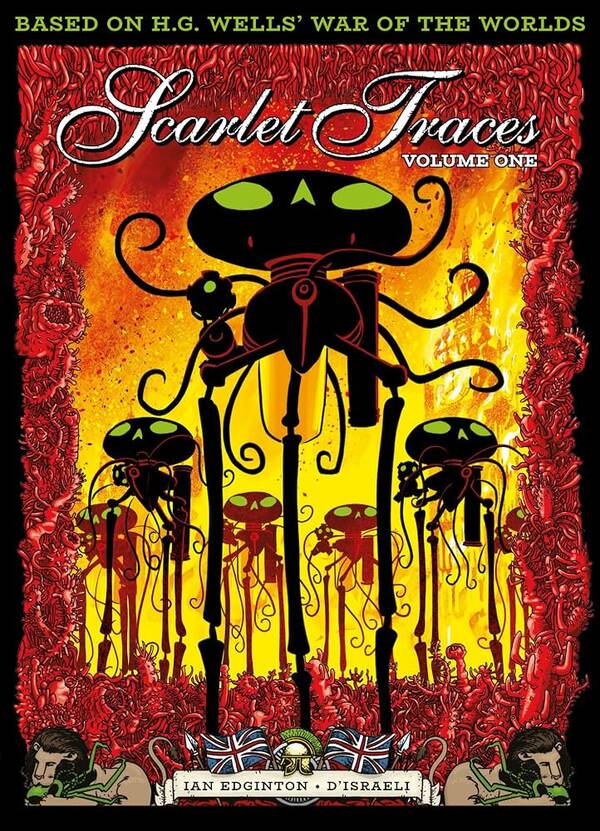
Scarlet Traces
Written by Ian Edginton. Art by D'Israeli.
Britain survives the Martian invasion and begins remaking itself with alien technology.
Overview
Ian Edginton and D'Israeli created Scarlet Traces as a sequel to H. G. Wells's The War of the Worlds, first appearing online in the early 2000s before print editions. It imagines the social and political aftermath of humanity's victory over Mars.
The alternate history asks what the winners would do with the defeated invaders' machines. A mystery framework reveals the costs hidden beneath a triumphant national story.
Why It Matters
The comic makes “what happened next?” a serious political question. Winning an invasion does not prevent a state from reproducing the methods of an enemy.
Its steampunk surface works because it carries a critique of empire. Imported technology changes Britain's reach without improving its judgment.
The Science Fiction
Reverse-engineered Martian devices accelerate history. The resulting world is familiar enough to read as Britain yet altered enough to expose its assumptions.
The story asks whether technological advantage can be separated from conquest. The answer is pursued through institutions and consequences rather than a single invention.
Art & Visual Identity
D'Israeli merges period architecture with alien machinery, making the alternate history visually coherent. The old city has new power threaded through it.
The contrast between polished public spectacle and disturbing evidence gives the mystery its visual tension.
Read This If You Like
- War of the Worlds continuations
- Steampunk alternate history
- Mysteries about imperial power
- D'Israeli's historical science fiction