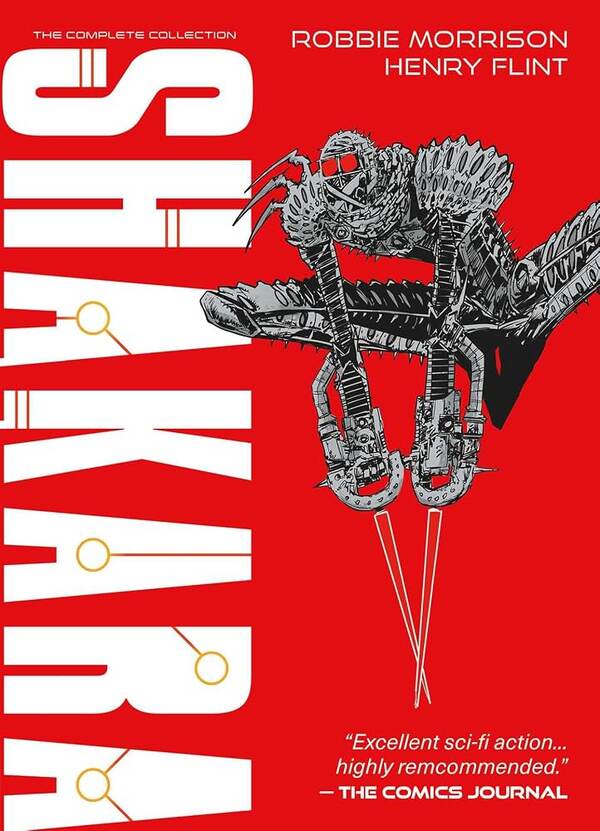
Shakara
Written by Robbie Morrison. Art by Henry Flint.
One survivor moves through a crowded alien galaxy with a single word and an immense debt to settle.
Overview
Robbie Morrison and Henry Flint's Shakara debuted in 2000 AD Prog 2002. The central figure is a remnant of a destroyed people, crossing a galaxy of hostile civilizations in pursuit of vengeance. The premise is direct, but each encounter enlarges the scope of the world that permitted the destruction.
The series turns revenge into a tour of alien power. Shakara's purpose is unwavering; the settings and opponents make the path unpredictable. The story draws energy from the gap between a near-silent protagonist and an extravagant universe.
Why It Matters
The strip uses 2000 AD's anthology form for a sustained cosmic saga. Rebellion's complete collection places the Morrison–Flint collaboration together, making visible how the early revenge premise expands into a larger account of civilizations and violence.
Its visual ambition is inseparable from its narrative identity. Flint's creatures and ships make the setting feel crowded with histories beyond the protagonist's immediate mission.
The Science Fiction
Alien civilizations supply the conflict's scale. Shakara passes through worlds governed by different powers, so the loss of one people becomes a question about how empires and species treat those they can erase.
The protagonist's near-singular drive gives the science fiction a mythic shape. The galaxy is full of complexity, while the survivor's response is brutally simple. The tension between those two scales keeps the revenge story from feeling small.
Art & Visual Identity
Flint's designs favor violent angles, dense surfaces, and large changes of scale. Shakara's sharp figure stands apart from many of the environments, helping readers follow him through complicated action.
The pages can overwhelm the eye with alien forms, then focus suddenly on a single movement. That rhythm gives the comic its force: the galaxy looks vast, but retaliation arrives with startling directness.
Read This If You Like
- Alien-civilization space opera
- Revenge stories on a cosmic scale
- Visually dense British science fiction
- Quiet protagonists in chaotic worlds