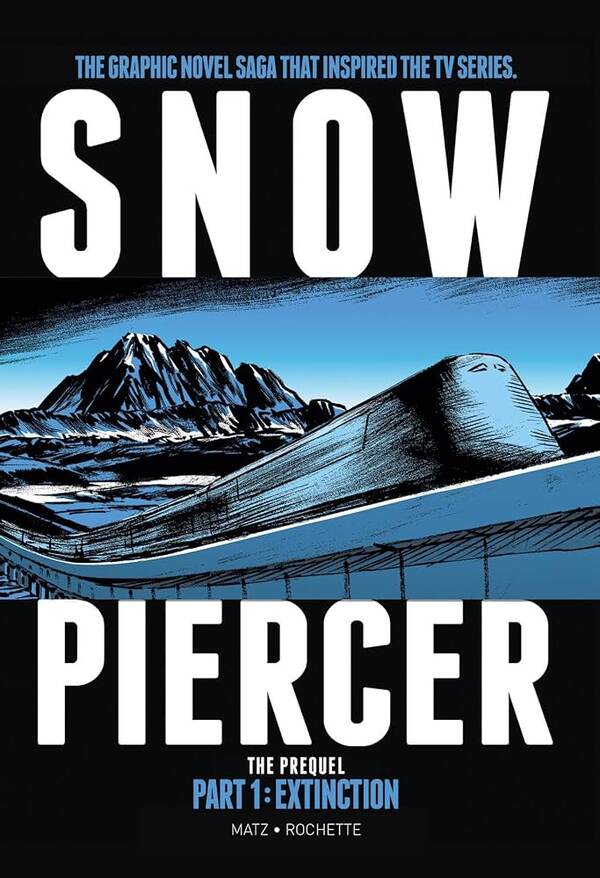
Snowpiercer (Le Transperceneige)
Written by Jacques Lob, Benjamin Legrand, Olivier Bocquet. Art by Jean-Marc Rochette.
A train circles a frozen Earth, carrying humanity's survivors and its old inequalities with them.
Overview
Jacques Lob and Jean-Marc Rochette's Le Transperceneige began in the French magazine (À Suivre) in 1982. Its endless train holds the remnants of humanity after a global freeze. The cars are sharply divided by class, turning physical movement toward the front into a journey through a social order.
Later Snowpiercer books brought in other writers, including Benjamin Legrand and Olivier Bocquet. This profile centers the original Lob–Rochette story while recognizing that its world became a larger series.
Why It Matters
The setting makes inequality impossible to treat as an abstract statistic. Resources, comfort, and authority have literal positions on the train. A character crossing a door also crosses a political boundary.
The work's long afterlife includes later books and screen adaptations, but its central image remains powerful on its own: a society claims it must keep moving, even as that motion preserves an unjust arrangement inside.
The Science Fiction
The frozen planet turns the train into a closed ecosystem. Heat, food, and space are limited, so control over distribution becomes a form of government.
The premise asks what survival is worth if the survivors reproduce the hierarchy that helped define the world they lost. Its speculative catastrophe sharpens a social problem rather than replacing it.
Art & Visual Identity
Rochette's stark train interiors make the cars feel narrow and lived in. Crowds and barriers create pressure even before a confrontation begins.
The contrast between cramped human space and the vast, hostile white outside gives the story its visual scale. The train is shelter, prison, and social map at once.
Read This If You Like
- Post-apocalyptic class allegories
- Closed ecosystems under stress
- French science-fiction comics
- Settings that make politics physical