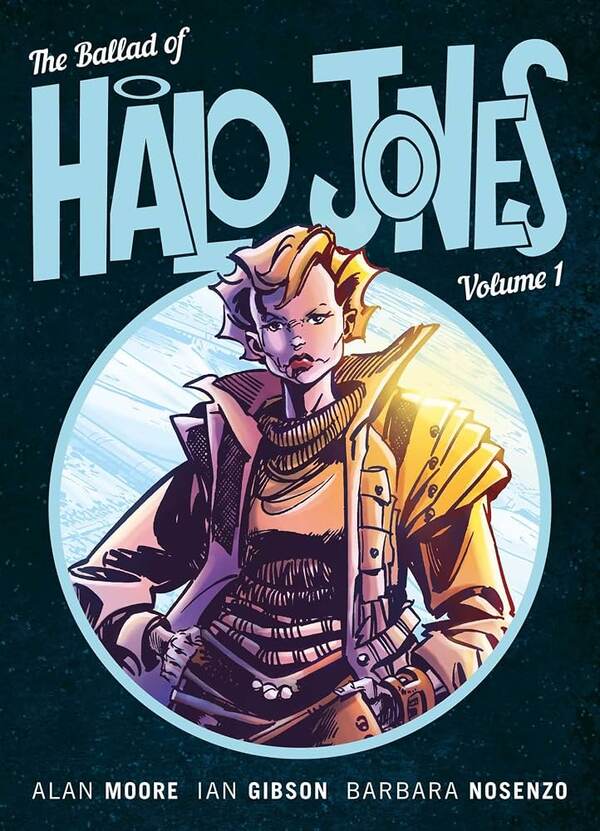
The Ballad of Halo Jones
Written by Alan Moore. Art by Ian Gibson.
An ordinary young woman wants to leave the place that has defined her, and space proves much larger than escape.
Overview
Alan Moore and Ian Gibson's The Ballad of Halo Jones began in 2000 AD in 1984. Halo is an eighteen-year-old living on the Hoop, a crowded leisure-housing estate in the fiftieth century. Her wish to get out leads from everyday frustrations toward travel, work, and an interstellar war.
The series changes scale as Halo's life changes. It starts with the texture of a constrained home, then lets each new setting complicate the promise of freedom. Halo is not introduced as a warrior or an appointed savior; her ordinariness is what gives the larger events their human measure.
Why It Matters
Rebellion presents the comic as a feminist space opera, and its premise explains why that description matters. Halo's desire for a life beyond the Hoop is treated as a serious engine for science fiction. The setting's sweep grows from her choices rather than forcing her to serve as a guide to an already fixed universe.
The strip also showed how a weekly anthology could sustain a life story across distinct books. Its shifts in place and tone reward readers who notice the distance between Halo's original hope and the experiences she accumulates. The epic is built from ordinary decisions before it reaches extraordinary events.
The Science Fiction
The Hoop gives the future a social structure before the story offers a tour of space. Housing, leisure, and limited opportunity define what Halo wants to escape. Interstellar travel then changes her circumstances without guaranteeing autonomy.
The later war widens the story's political horizon. Science-fiction scale permits Moore and Gibson to ask how an individual life is redirected by systems too large to control. Space is both possibility and another terrain of inequality, work, and conflict.
Art & Visual Identity
Gibson's character work makes Halo and the people around her readable as individuals within busy speculative settings. His original black-and-white pages rely on clear silhouettes and expressive faces, allowing the social comedy of the Hoop to sit alongside more imposing future environments.
The art has to carry a changing story: intimate routines, movement through new places, and the machinery of war. Gibson keeps Halo present within those shifts. The reader can follow her changing relationship to the world even as the world grows visually larger.
Read This If You Like
- Character-led space opera
- Feminist science fiction
- Stories about leaving home and finding limits elsewhere
- British anthology comics of the 1980s