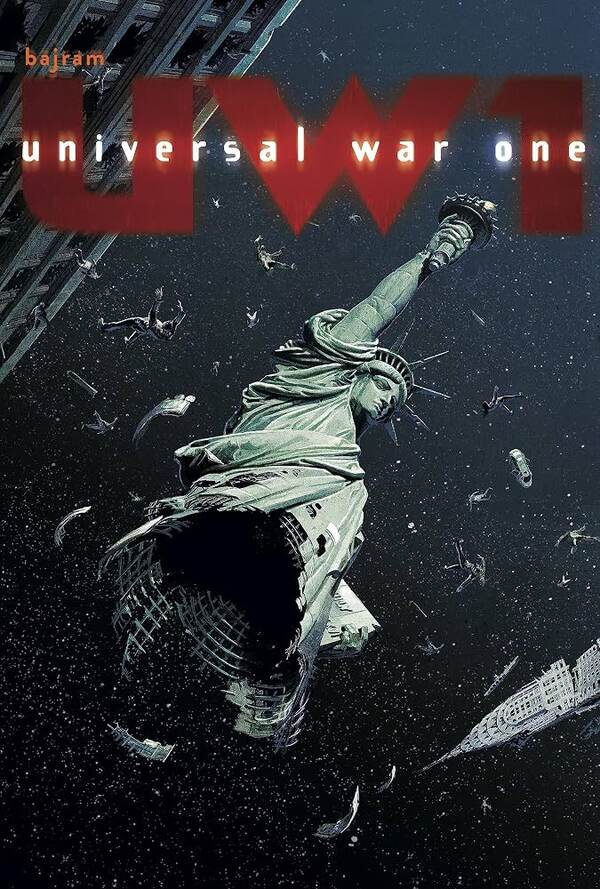
Universal War One
Denis Bajram
A military mission at the edge of an anomaly becomes a test of time, command, and survival.
Overview
Denis Bajram began the French science-fiction series Universal War One at Soleil in 1998, writing and drawing it himself. Its opening places a troubled military crew near a vast spatial anomaly. What first seems like a mission with a defined target grows into a conflict involving time and the future of human civilization.
The series uses the crew as a way to keep enormous events comprehensible. Orders, loyalties, and personal histories shape how its members respond when ordinary assumptions about sequence and causation stop holding.
Why It Matters
Bajram's single-author approach gives the narrative and visual planning a close fit. The ships and technical situations are not background decoration: they set limits within which the characters must act. That makes the escalating premise easier to follow even as its time structure grows more difficult.
The 1998 date marks the start, not the completion, of the multi-volume story. Read as a sequence, its strongest effect comes from seeing early decisions acquire meanings the characters could not yet know.
The Science Fiction
Time travel changes the stakes of military action. A choice can affect more than the immediate battle, and knowledge of an event may arrive in the wrong order. The series treats chronology as a strategic problem rather than simply a device for surprise.
The spatial anomaly also gives the conflict a scale beyond ordinary territorial war. It challenges the crew's ability to separate technical explanation from human responsibility, making each new discovery morally consequential.
Art & Visual Identity
Bajram's clean machinery and mapped spaces help readers understand where a crew is operating. Wide views establish scale, while close scenes return to faces and decisions inside the equipment.
The tension between orderly design and temporal disruption is part of the visual storytelling. The art gives readers stable points of orientation so the story can unsettle the order of events without losing its human center.
Read This If You Like
- Time travel with military consequences
- Large-scale European science fiction
- Technical settings tied to character choices
- Long plots that reinterpret earlier events