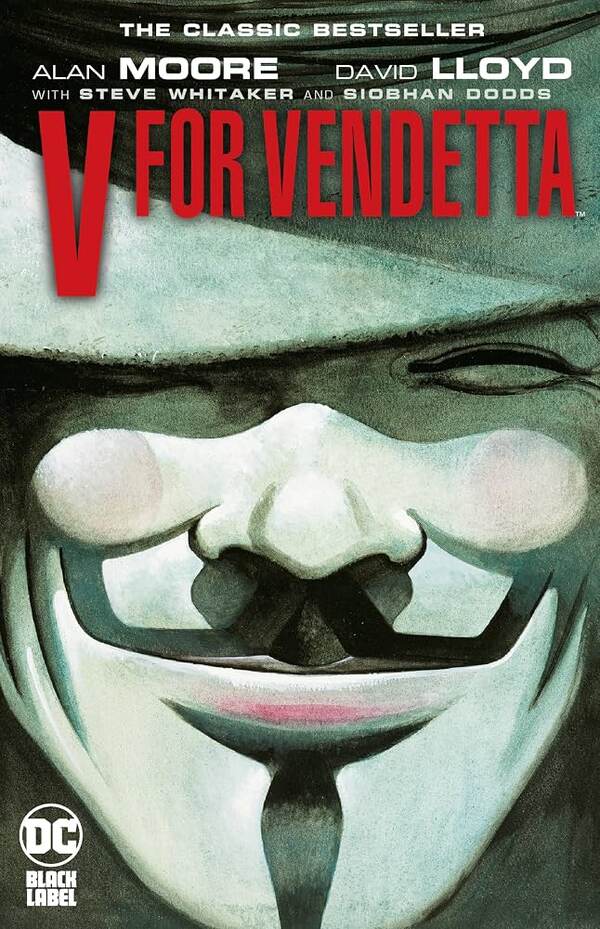
V for Vendetta
Written by Alan Moore. Art by David Lloyd.
An anonymous insurgent turns a totalitarian state into a stage for arguments about freedom and fear.
Overview
Alan Moore and David Lloyd began V for Vendetta in Britain's Warrior magazine in 1982; DC later completed it in 1988–89. Set in a near-future Britain under authoritarian rule, the story follows the masked V as he attacks the regime and draws Evey Hammond into his campaign.
The plot mixes pursuit, political conspiracy, and moral debate. V's theatrical acts make power visible, but the comic does not let spectacle alone answer whether his methods can build the freedom he invokes.
Why It Matters
Its serial history matters: the story crossed publishers before becoming the collected graphic novel many readers now know. DC calls it a portrait of totalitarianism and resistance, a description grounded in its conflict over surveillance, obedience, and political violence.
The work remains challenging because it gives both the regime and its opponent methods that demand scrutiny. The mask can be read as an invitation for anyone to resist, while V's control over others complicates that invitation.
The Science Fiction
The future setting exaggerates political tendencies rather than centering a technological invention. State control reaches into information, movement, and daily conduct, making the speculative society feel frighteningly administrative.
Its dystopia asks how people learn to live with repression, and what it costs to break that habit. The imagined near future supplies distance from the present while keeping the questions recognizably civic.
Art & Visual Identity
Lloyd's dark compositions give streets and interiors a sense of enclosure. V's pale mask interrupts those shadows, making him instantly legible and unsettling even when his expression cannot change.
That fixed face forces the art to use posture, framing, and the reactions of others to convey V's effect. The visual restraint suits a story about appearances, identity, and the gap between a public symbol and a private person.
Read This If You Like
- Political dystopias
- Thrillers about surveillance and resistance
- Masked identities used as arguments
- Dark, theatrical comics art