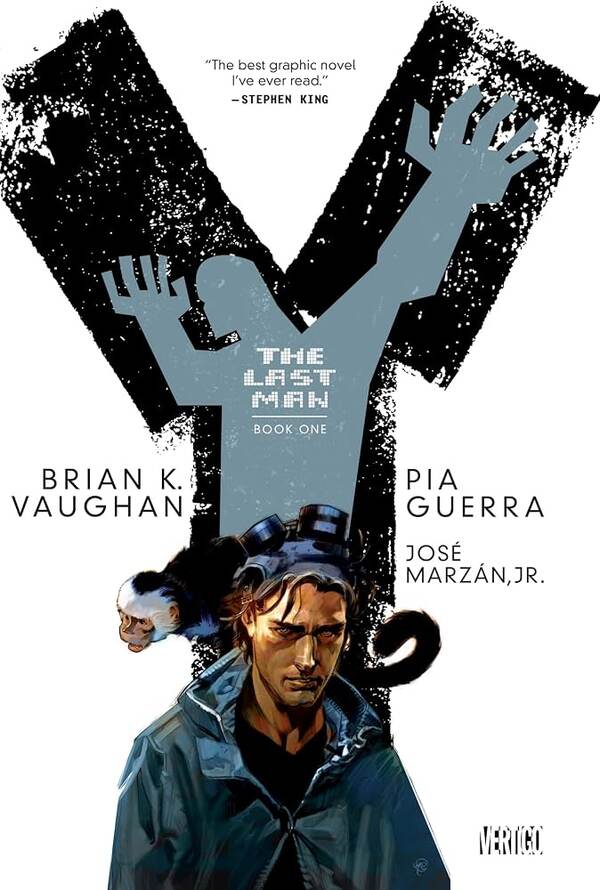
Y: The Last Man
Written by Brian K. Vaughan. Art by Pia Guerra, Goran Sudžuka.
After a global die-off, survival is only the start of Yorick Brown's problem.
Overview
Brian K. Vaughan and Pia Guerra's Y: The Last Man began under DC's Vertigo imprint in 2002. A sudden catastrophe kills mammals with a Y chromosome, leaving Yorick Brown and his monkey Ampersand as exceptional survivors. With a government agent and a geneticist, Yorick travels through a world reorganizing under the shock.
His search for a loved one gives the journey a personal direction, but the comic repeatedly widens to the people and institutions reshaped by the event. The premise invites a simple survival mystery; the longer story asks how societies distribute power, work, and care after an abrupt demographic collapse.
Why It Matters
The series won the 2008 Eisner Award for Best Continuing Series. Its success rested partly on making a huge speculative event readable through a mobile cast and a clear narrative question: why did Yorick and Ampersand live?
The comic also shows how a provocative premise can generate many local stories. Each stop on the journey reveals a different response to loss and uncertainty. The strongest tension often lies between what Yorick wants for himself and what others believe his survival means for them.
The Science Fiction
The unexplained die-off is the story's central speculative rupture. Its immediate effects are biological, but its consequences are political and social. The question of cause keeps the plot moving while encounters along the route examine the systems that depended on the world as it was.
Yorick's exception does not make him automatically capable or wise. That choice keeps the science-fiction mystery tied to character: an extraordinary status falls on a person still trying to understand ordinary obligations.
Art & Visual Identity
Guerra's clear, expressive line keeps the cast legible as the setting changes. DC has noted how her smooth, bold drawing supports a dark post-apocalyptic story. Faces and gestures carry negotiations that are as important as the sudden dangers of travel.
The visual continuity matters for a series crossing many environments. Readers can track relationships and shifting trust without each location needing a new design spectacle. The art gives the premise room to become a human story.
Read This If You Like
- Post-apocalyptic travel narratives
- Social consequences of a single speculative event
- Ensemble stories with an ongoing mystery
- Character-led Vertigo comics