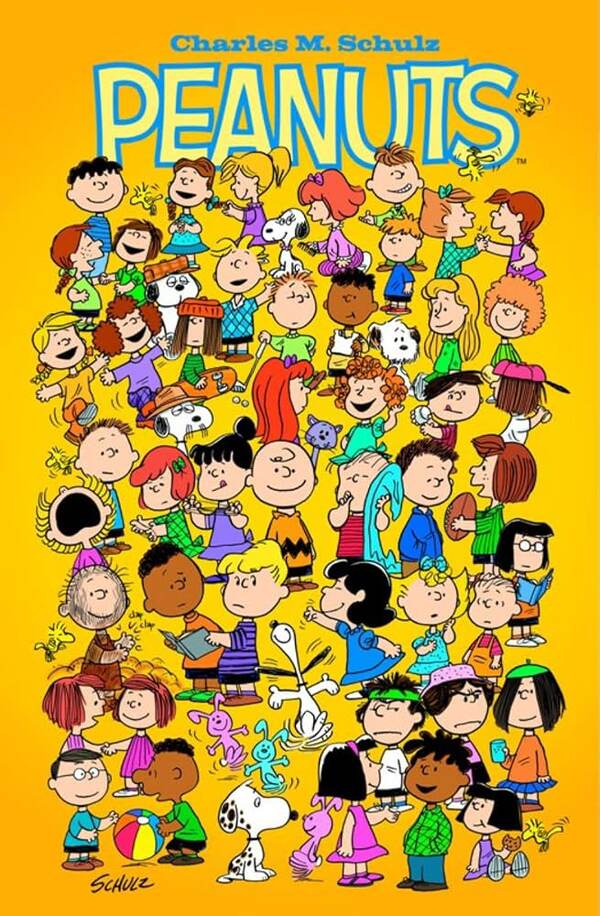
Peanuts
Charles M. Schulz
Childhood becomes a place for wit, worry and stubborn hope.
Overview
Charles M. Schulz introduced Charlie Brown and the Peanuts cast in 1950. Their daily encounters include friendship, rivalry, school, sports and the private dramas of small disappointments.
The strip turns modest situations into enduring character stories. Charlie Brown’s defeats, Lucy’s certainty, Linus’s questions and Snoopy’s imagination each give a different angle on the same small world.
Why It Matters
Peanuts reached newspapers around the world over a fifty-year run. Its scale of circulation matters, but its achievement is formal too: a few panels can move from a joke to loneliness or generosity.
Schulz trusted repeated characters and slight changes of expression to do much of the storytelling.
Genre & Themes
The work is a humor strip with philosophical undercurrents. The children speak with adult complexity while remaining recognizably vulnerable to childish fears and pleasures.
Failure is frequent, yet the strip keeps making room for another attempt tomorrow.
Art & Visual Identity
Schulz refined a spare line that makes posture, timing and a raised eyebrow legible at once. White space gives conversations room to breathe.
The simplicity lets an imagined flight or an ordinary sidewalk feel equally immediate.
Read This If You Like
- Character-driven newspaper strips
- Childhood philosophy
- Gentle social comedy
- Brief stories with emotional depth