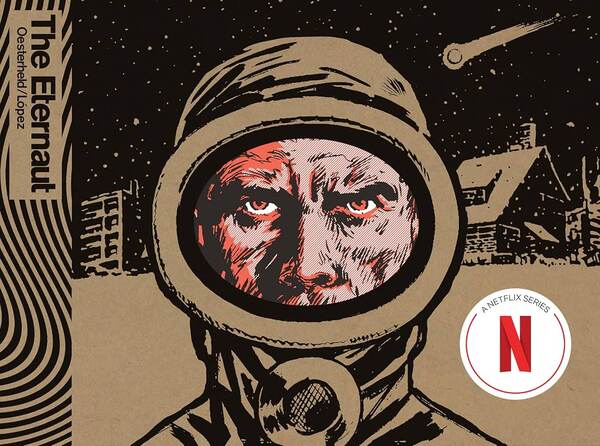
The Eternaut (El Eternauta)
Written by Héctor Germán Oesterheld. Art by Francisco Solano López.
A deadly snowfall seals a Buenos Aires neighborhood inside an invasion no one can yet see.
Overview
Written by Héctor Germán Oesterheld and drawn by Francisco Solano López, The Eternaut was serialized in Argentina from 1957 to 1959. The first catastrophe is deceptively quiet: strange snow falls over Buenos Aires, killing people who step outside. Neighbors must improvise protection and learn the rules of a threat that is only the beginning of a larger alien invasion.
Its survival story grows outward from a familiar home. Ordinary people become an improvised collective, testing ideas and making dangerous journeys as their city changes around them. The science-fiction machinery matters, but the tension comes from how quickly knowledge, trust, and cooperation become necessities.
Why It Matters
Fantagraphics describes the work as a landmark of Argentine comics and a lasting symbol of resistance in Latin America. That standing also belongs to its historical context: Oesterheld later opposed Argentina's military dictatorship and was disappeared in 1977. Readers can see the invasion story's attention to power and solidarity without collapsing the 1950s comic into a simple prediction of later events.
The story gains force by refusing to give its survivors immediate mastery. Its protagonists do not begin as chosen defenders or experts in an alien war. They have to interpret incomplete evidence together. The result is an invasion narrative whose suspense is shared across a group rather than concentrated in a single savior.
The Science Fiction
The lethal snow turns an ordinary street into hostile territory. The question is initially practical: how can anyone cross a few meters safely? From that constraint the narrative opens onto a much larger structure of invasion and control. Each discovery changes what the survivors think they are fighting.
This scale shift gives the work its political edge. Threats arrive through systems that are difficult to see or understand, while resistance begins with local knowledge and mutual dependence. The speculative premise lets the comic examine fear, obedience, and collective action through an urgent adventure.
Art & Visual Identity
Solano López renders Buenos Aires as a place of recognizable houses and streets before turning it strange. In black and white, the snowfall can look nearly blank, making small figures and dark interiors carry the danger. The contrast between ordinary surroundings and lethal conditions keeps the disaster close to daily life.
His representational drawing makes the ensemble readable during moments of confusion. Clothing, posture, and the arrangement of bodies help track who is protected, exposed, or left behind. The art's clarity supports the serial's central rhythm: a practical problem is solved just as a larger one comes into view.
Read This If You Like
- Alien invasions from an ordinary citizen's view
- Survival stories about collective action
- Latin American science-fiction comics
- Black-and-white serial adventure art