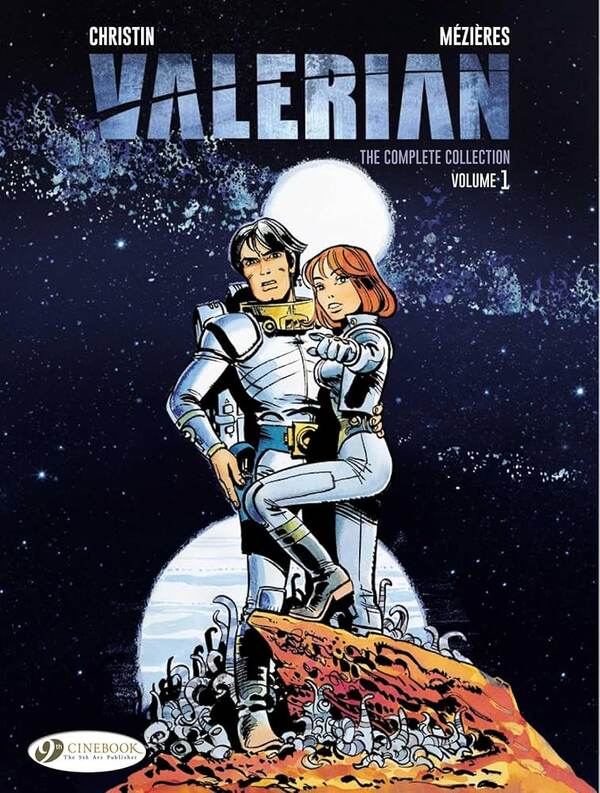
Valérian and Laureline
Written by Pierre Christin. Art by Jean-Claude Mézières.
Two agents cross centuries and galaxies, discovering that the most interesting worlds refuse to follow anyone's orders.
Overview
Pierre Christin and Jean-Claude Mézières introduced Valérian and Laureline in the French magazine Pilote on 9 November 1967. They are spatiotemporal agents of Galaxity, sent through the universe and across eras on assignments that turn travel into investigation. The series grew from short adventures into an expansive sequence of albums.
The appeal lies in the pair's different ways of meeting the unfamiliar. Their journeys include invented societies, commerce, diplomacy, and conflicts over who gets to decide a civilization's future. In Ambassador of the Shadows, for example, Point Central brings many peoples together in a vast artificial meeting place, making political difference part of the adventure itself.
Why It Matters
At its debut, science fiction offered Christin and Mézières room to build a distinctive French comics serial. Dargaud records a run spanning decades and translations into many languages. The series' longevity rests on more than its gadgets: each new destination lets its creators test assumptions that the travelers bring from home.
Its strongest episodes make the heroes visitors rather than automatic authorities. Dargaud describes Ambassador of the Shadows as a story in favor of peoples' self-determination. That gives the spectacle a point of view: an alien city or species is not simply scenery when its political choices can challenge the agents' mission.
The Science Fiction
Time travel and space travel give the series a double scale. A mission may cross astronomical distance, but it can also put the agents in contact with another historical moment. Galaxity's reach promises order, while the places outside its control supply the surprises that make the story move.
Point Central is a telling invention: a built environment shared by different populations. It turns the familiar space-opera hub into a question about negotiation and coexistence. The books repeatedly use imagined geography to ask how people communicate when their interests, bodies, and histories differ.
Art & Visual Identity
Mézières gives the series its sense of inhabited variety. His designs make vehicles, clothing, and creatures feel tied to their surroundings, so the reader can take in a new setting before an explanation arrives. Crowded spaces reward looking around the protagonists rather than only following them.
Dargaud credits Évelyne Tranlé with color work on the series. Across its many environments, color helps separate cultures and locations without flattening them into a single futuristic style. The shifting visual register is part of the pleasure: each stop looks like a place with a life beyond the current assignment.
Read This If You Like
- Space opera built around travel and encounters
- Time travel with political consequences
- Inventive alien cities and cultures
- Franco-Belgian adventure comics