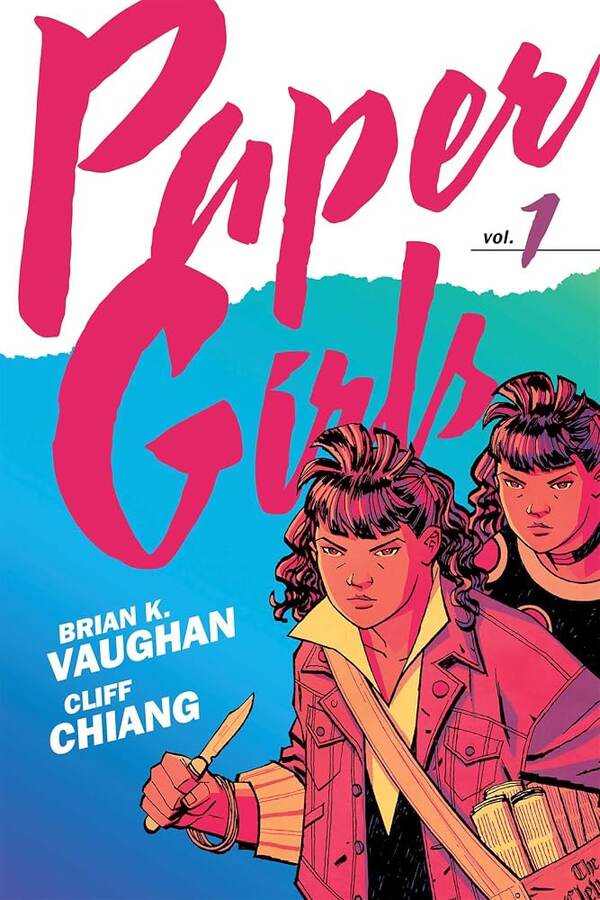
Paper Girls
Written by Brian K. Vaughan. Art by Cliff Chiang.
Four newspaper delivery girls leave home before dawn and find time itself has become unreliable.
Overview
Brian K. Vaughan and Cliff Chiang launched Paper Girls at Image Comics on 7 October 2015. It begins after Halloween in 1988, when four twelve-year-old girls on their paper route encounter events far beyond their neighborhood. The ordinary work of delivery gives the opening mystery a precise place and hour.
The story grows into a time-travel adventure, but the group remains its anchor. Each girl brings a different attitude to danger and change. Their friendship is tested by encounters with unfamiliar futures and by the unsettling possibility of seeing who they might become.
Why It Matters
The series uses a child-sized starting point for large science-fiction questions. The girls are neither trained explorers nor passive witnesses; they try to make sense of contradictory evidence while protecting one another.
Its 1988 setting gives time travel an emotional edge. The past is someone's present, with its own expectations about growing up. When later eras intrude, the story can ask what the future owes the children who must live into it.
The Science Fiction
Time travel disrupts both chronology and identity. A meeting across eras can change the meaning of a memory or an ambition, making the mystery personal as well as cosmic.
The speculative machinery is most effective when it puts pressure on the group's trust. Their route home is no longer a reliable map, so friendship becomes a practical way of navigating uncertainty.
Art & Visual Identity
Chiang's bold silhouettes make the four girls easy to distinguish even in fast-moving scenes. Matt Wilson is credited on the first issue's art team; the color gives its suburban dawn and strange interruptions a vivid contrast.
The visual shift from familiar streets to unfamiliar events gives the premise force. Ordinary houses and bikes remain recognizably ordinary, which makes the impossible feel as though it has truly arrived in the neighborhood.
Read This If You Like
- Time travel through a coming-of-age lens
- Group friendship under pressure
- 1980s settings with speculative disruption
- Colorful, character-led adventure comics